
Revisiting "Into Thin Air"
Thirty years after the 1996 Mount Everest disaster, I’m republishing Chapter 1 of my memoir Into the Soul of the World, about my entanglement with the story while working as a young editor at Outside.

Hi friends,
Welcome back to my newsletter, where I share stories from the life of a working writer, reflections on memoir, creativity, travel, and the mystery of being alive in a human body.
These essays are a labor of love, and they’re made possible by readers like you. If this post resonates, I’d be grateful if you’d like it, leave a comment, subscribe, upgrade to paid, share it with a friend, or support my memoir, Into the Soul of the World, in print or on Audible.
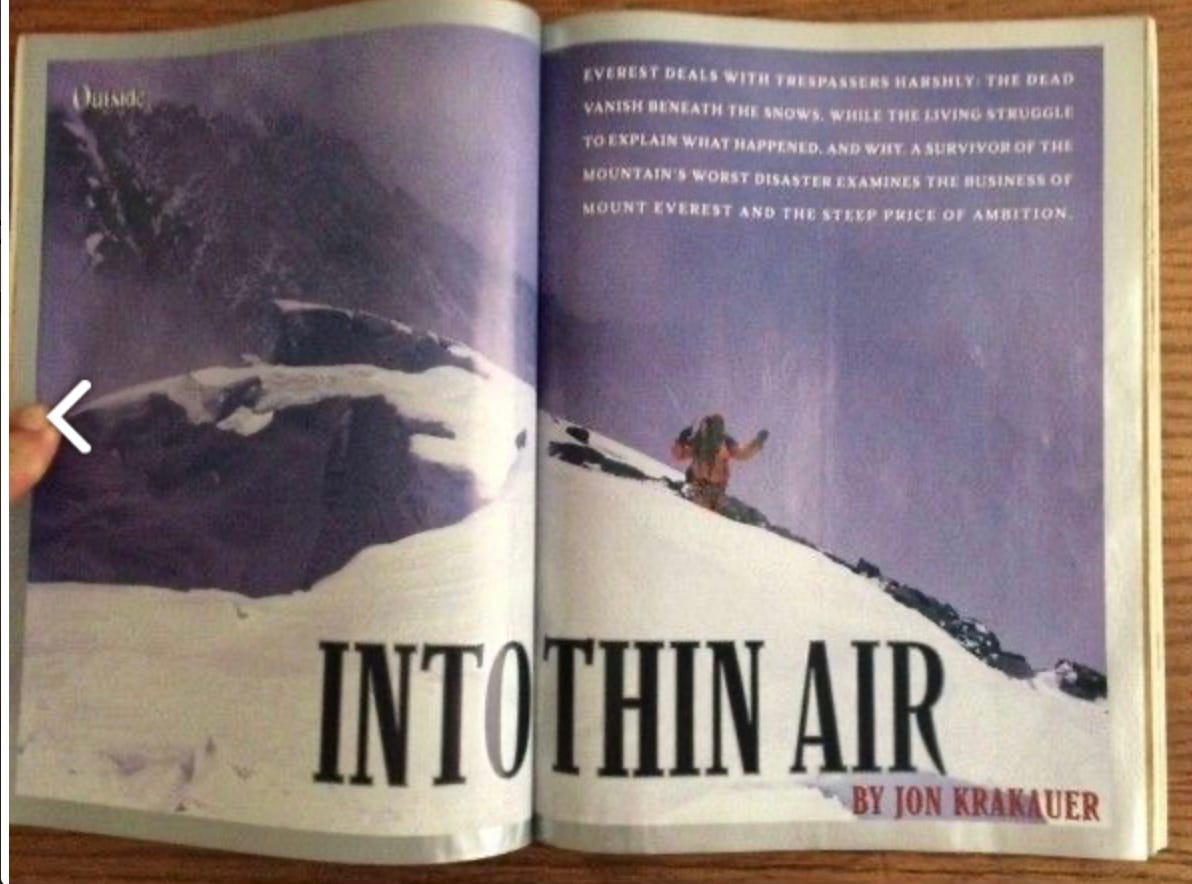
This week marks the 30th anniversary of the 1996 Mount Everest tragedy. Here’s the story of my involvement with “Into Thin Air,” the longform piece that ran in the September 1996 issue of Outside, where I worked as an editor for more than six years.
It’s hard to believe three decades have passed. I still remember those days with startling clarity. The phone calls. The tension in the office. The feeling that
something immense and terrible had happened high on that mountain, and that all of us connected to the story were trying to make sense of it in real time.
I was only 30 years old then. I’ve been through a great deal since those days. I’m certain you have too.
I’ve only spoken to Krakauer once since then, thought we live in the same town.
I remember those months of May, June, and July of 1996 as if they happened yesterday. I’ve since read that Krakauer struggled with PTSD afterward and
came to regret going to Everest. I understand that more deeply now than I once did. I’ve had my own battles with PTSD over the years over events in my own life—and I’ve worked hard to heal it. And yet those weeks in 1996 remain inked into my soul.
When you’re an editor, some experiences keep unfolding inside you long after the world has moved on.
Here is my story, as told in Chapter 1 of my memoir, Into the Soul of the World.
A Mountain of a Story
The first time I heard from our writer on Everest after the 1996 tragedy, I was seated at my desk, nibbling on a green chili breakfast burrito and reading the New York Times online. My computer’s screen was filled with plane crashes and small wars in far-off nations. President Clinton grappled with gay people in the military.
My sunny, light-filled office on the second floor of Outside magazine’s southwestern- themed building felt peaceful in comparison. It was just before 9 a.m. A cool morning breeze moved through my open balcony door—that clean
mountain air. Across the street, I watched tourists posing for pictures next to an old train stop in the Santa Fe Railyard. Then the phone rang. I almost didn’t pick up. Unless I was expecting a call, I rarely answered before nine.
I certainly wasn’t expecting to hear that voice, which I recognized as soon as he spoke.
Today, author and journalist Jon Krakauer’s first words still rattle around my head like lost dice. I would have known his efficient, clipped tone if he’d been speaking into one of those homemade toy phones made from two plastic cups linked by ten feet of kite string--or the distance of an ocean.
“Hey, Brad.”
“Jon?” I gripped the phone tightly and pulled on the cord, trying to move it a few inches toward the door so I could take the call bon the sunny balcony under the famous New Mexico sky, big and dotted with perfect-looking clouds, the mountains rising in the distance. I wanted to feel more connected—or at least less disconnected—to this writer who had just survived the deadliest day on the world’s highest mountain while reporting a story for the magazine.
“Wait a second.”
I was confused. The last I’d heard through from Mark Bryant, the editor of Outside, my boss, and, in those days, Krakauer’s editor and primary contact on all his stories for the magazine, our writer had made it safely back to base camp after a fast-moving blizzard pounded the granite peak on a day when dozens were descending from the summit. The storm had caught the climbers off guard. Some never made it off the summit ridge while others hurried toward their campsite down dangerous slopes in whiteout conditions. Some climbers made it back to their tents. But others become confused and lost and froze to death or fell off the mountain’s steep slope. Eleven climbers were either dead or missing and presumed dead. We editors eventually learned that Jon had made it safely back to his tent, and a few days later, we learned that he had arrived back at base camp. From there, we thought he’d have to trek back out to civilization. So, we weren’t expecting to hear from him for more than a week. Which is why I was confused, and overwhelmed, but more than anything else, relieved to hear his voice. He was alive.
“I’m in Kathmandu. I’m at a hotel.”
He then explained that instead of trekking back out he and the other climbers had been picked up by a helicopter at Pheriche, a village with a small hospital about 8 miles from Everest base camp.
“Fucking A, Jon. I can’t tell you how glad I am to hear your voice. I know this is a stupid question, but are you okay?” It was the only question I could think to ask.
I tried to picture the best-selling author of Into the Wild, a consummate adventure writer, and a longtime contributor to our magazine, in the aftermath of what he’d just gone through. Of course, I had zero ability to relate to the traumas he’d experienced on the mountain. I’d sat on my ass in a climate- controlled office for the past eight weeks worrying while he’d bled and suffered in more ways than I could comprehend.
I listened as he filled me in on a few details of the scene on the mountain after the storm and the conditions of some of the climbers with whom I was familiar.
“Fuck,” I said.
As I spoke, I felt a wave of emotion and even fought back a tear.
Why? I’m not sure. I didn’t know Krakauer. We had spoken several times over the years about fact-checking and minor editorial matters, more often during the six months before the climb when I was working the phones to try to land him on a commercial guided climbing team. Moreover, I and the other editors bore no responsibility for his safety, and none of us could take any credit for his success on the mountain. I had offered him the story idea to go to base camp and write about Everest. But the idea to climb to the summit of Mount Everest had been his. As Mark recently told me: “Our idea was to have somebody of Krakauer’s credibility cover Everest’s growing commercialism from base camp. We certainly didn’t aspire to put one of our writers’ lives at risk by going to the top.”
Furthermore, we editors hadn’t done an ounce of the real work. We hadn’t put ourselves in exceedingly dangerous places. Nor had we suffered a wit. And yet... I was flooded with emotions, and even today I’m not sure why. I guess it was because I had expended significant emotional capital worrying about him. All of
us editors had. And this: on some level, I, a 30-year-old associate editor who was taking this call from Krakauer, suspected that Krakauer and the other climbers who survived that brutal storm on Mount Everest on May 10, 1996, would have a difficult time healing from the trauma and finding peace. If ever they did.
But this moment wasn’t about me. This phone call, this magazine story. None of it was about me.
We continued talking for another few minutes. He told me a little about what he’d been through, and then he said he had plans to start writing very soon after he returned to Seattle.
“No, no, I spoke with Mark about this. He said to tell you that you can take all the time you need. I mean, you could wait a year to write this story. We don’t care. Just get home and get rested and recovered. We can talk in a few weeks or longer.”
“Do you know if Mark’s around?” Jon usually consulted only with Mark.
“I haven’t seen him.”
I looked down at the manila folder with MOUNT EVEREST scrawled across the cover in thick black pen, the file that contained nearly two years of my notes, clipped articles, and correspondence from guiding companies.
I became lost in thought. Since my first days as an intern at the magazine, I had been an armchair Everest buff, reading books, watching videos, and keeping tabs on each climbing season. Why? I’m not sure I know. This is just what I do. I become obsessed; I go down rabbit holes. Eventually, I got promoted to assistant editor and became the maven of the magazine’s adventure beat. I began keeping a file about Everest. Soon my file grew thick with articles and written notes from my interviews with various Everest experts. Some of these experts kept telling me that we editors should send a writer to Everest to write about the rise of commercially guided expeditions. Several new outfits were advertising their services and promising potential clients they’d do the hard work of setting ropes, carrying heavy gear, making camp, calling the tactical shots--practically everything except the actual climbing. The cost to the client: $65,000.
Eventually, during the winter of 1993-1994, I wrote a story pitch in which I’d argued that we should get a writer to base camp sooner than later. “Eventually, the shit will hit the fan,” I stated. I delivered the pitch in an editorial meeting in the conference room of our offices then located in downtown Chicago. At the end of the pitch, I suggested we consider both mountaineering writer Greg Child and Jon Krakauer as potential writers.
That far tamer Everest story was largely forgotten. It never happened. But I remained vitally interested in all things Everest. We did offer it to Krakauer in March of 1995. He accepted it—then a few weeks later he changed his mind and turned it down. And then he surprised us all when later he called Mark and said that he would go to Everest if we got him on a team and that he wanted to try to climb to the top.
I was beyond thrilled when I heard this. This was even better. Practically all of us at the magazine began working toward making this story happen. And Mark was kind enough to anoint me chief shepherd of the nascent project. Thus, Krakauer called me when he couldn’t track Mark down.
I must have spaced out ten seconds. When I drifted back to reality, Krakauer was ready to get off the phone. “Gotta go, Brad.”
“Okay, well. Take it easy on yourself. You’ve been through a lot.” As if this seasoned mountaineer and journalist needed life advice from me.
Thus began the final chapter of my six-year career as an up-and-coming editor at one of the nation’s most respected, award-winning magazines. In my work as editorial project manager of the Everest story, I had primarily made a lot of phone calls. I’d helped get Krakauer a place on a premiere mountain guiding company. Other than that, I’d prayed a lot for his safe return. I suppose I became overly exuberant. In my head, I was already writing my own press releases. I believed my involvement in this Everest story would help me fulfill my dream of becoming an adventure writer myself. As the summer wore on, I shepherded Krakauer’s story through the editorial process at Outside. When the managing editor set the manuscript on my desk, I took my turn at editing it. I oversaw the team of fact-checkers and the creation of the two-page graphic sidebar. I found myself being interviewed on camera for ABC News at Mark’s request. A month later, Mark promoted me to senior editor. And after the story appeared on newsstands in the September 1996 issue of Outside with bold lettering that read “The Story on Everest,” I sat for dozens more radio, TV, and newspaper interviews. I began receiving phone calls from editors of other magazines offering me writing assignments for adventure-related stories. I had it all figured out; it had never been my goal to become a great editor of adventure stories; my goal was to be the adventure writer himself.
In early November, about three months after “Into Thin Air” appeared on newsstands, I gave Mark my notice, packed my Outside office into boxes, thanked my boss and the rest of the staff, and set up a home office in the new house I shared with Di, my wife. If now wasn’t the perfect time to make my break and step into the life of my dreams, full of adventurous travel to exotic places, when would the right time be? In this moment, becoming a great adventure writer felt like more than just a dream—it felt, excuse the hyperbole, like my destiny.
It all sounds so logical and reasonable now. As I organized my new home office, there was one memo I didn’t get or at least didn’t read. If only I’d spent more time studying the writings of Freud and Jung, or at least just looked up the word destiny. If I had, I might have learned that destiny, it turns out, is a future scenario, one’s destination. We can dream about our destiny, the place we’d like to end up. But we cannot escape our fate, a word I should also have looked up, something a tad more twisted and dark. Fate is what the universe has planned for us, and its synonym, somewhat appropriately, is doom. If becoming a successful adventure writer was my destiny, then losing everything--and nearly losing my sanity and my life within ten years of the publication of “Into Thin Air”—was my fate.
I never could have imagined that within that decade, due to undiagnosed, untreated PTSD, I would be brought to my knees by visually graphic and other times purely emotion-driven flashbacks. I would end up too depressed to carry on and numbed out on a massive cocktail of twenty-three psychotropic pills per day. I could never have anticipated that I would become a housebound zombie, or that much later, I’d try to pull my life together by reimagining myself as a spiritual seeker on the road to redemption across the Holy Land. I certainly never could have predicted that I’d temporarily abandon my writing career to become a headband-wearing yoga teacher. Or that I’d endure the Mother of All Midlife Crises.
How could I have foreseen that I would one day kneel at the feet of a hundred-year-old yogi in a cave in the Himalayas and that he’d bless me by literally smacking me on the head, leading to a twelve-hour mystical experience during which the curtain of the Universe was pulled back for me, and I saw the unification of All?
As I sat in my office the day of that call, I thought I was building the foundation for a solid career as a journalist and travel writer. Who knew where that could lead, but lectures, books, fame, and material wealth were certainly my hoped-for destiny. I had no idea that I was a broken man, doomed to external adventures that were humbling and humiliating, as well as a man fated for a decade of challenging inner work needed to heal and finally make sense of my life.
All of this happened to me.
I’m still here to tell the story.
And today I’m thriving, healthy, and happy.
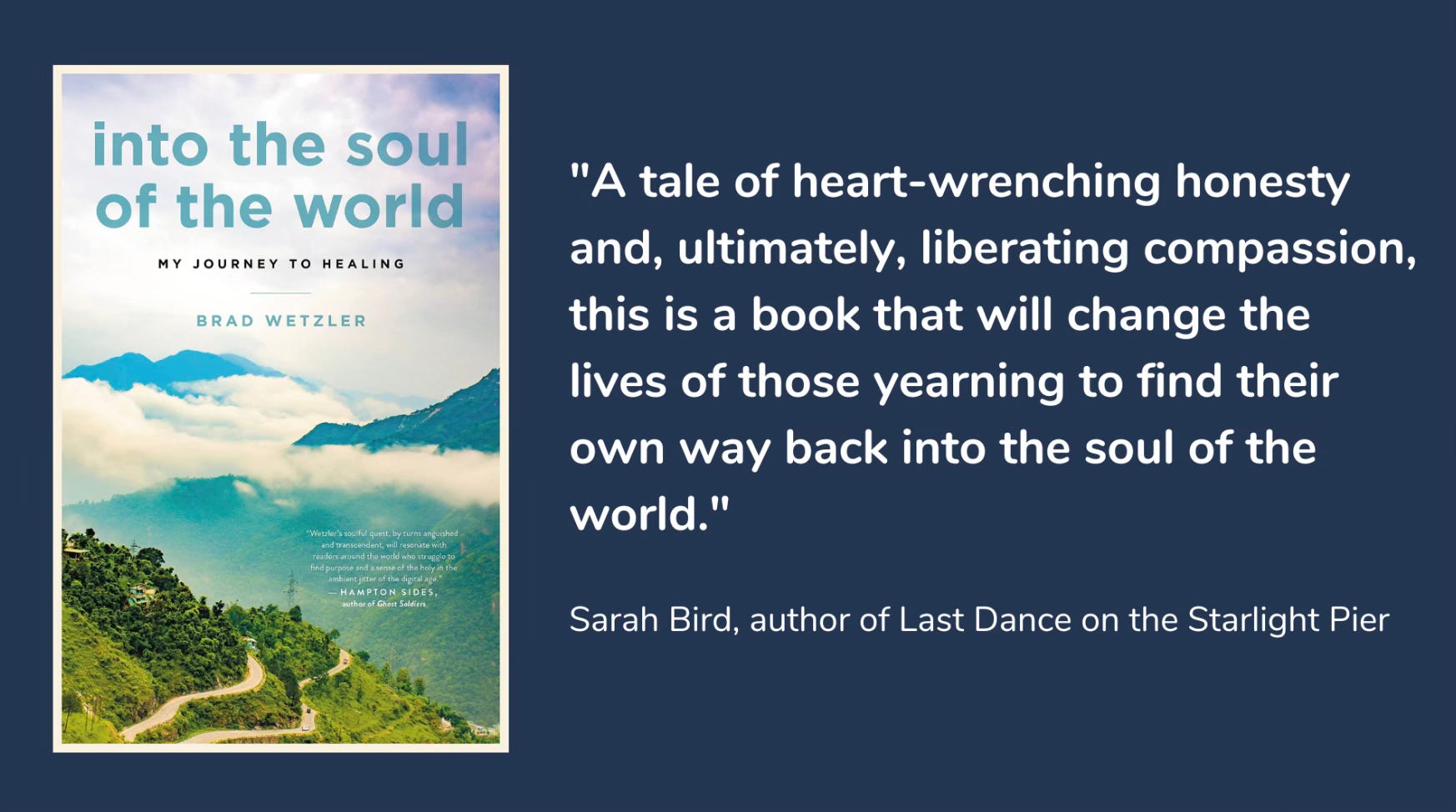
If you haven’t bought my memoir, Into the Soul of the World: My Journey to Healing, yet, I hope you will.
Here’s what author Hampton Sides wrote about it:
“Brad Wetzler has led the very definition of an adventurous life, but in Into the Soul of the World, he gives an unflinching account of his interior adventures. Wetzler’s soulful quest, by turns anguished and transcendent, will resonate with readers around the world who struggle to find purpose and a sense of the holy in the ambient jitter of the digital age.”

I'm happy to have discovered you, and your book. I followed the Everest story closely, and actually interviewed a few NZ climbers, around 1999, wanting to understand more, having devoured 100s of climbing books by then. An attempt at a bridge between the public, who only saw risk, and the climbers who knew why they climbed. K2, with Alison Hargraves and Bruce Grant, was the initial impetus. I'm off to find your book, and look forward to reading your Substack.
Legendary times. Thanks for sharing.